
Ambiguity Olympics
Knowledge. Optimization. Forever.


Understanding the actual steps required to make something real is the most important part of any endeavor. If you don’t learn how something is made then it’s hard to build a process and team that is the best at it. As a creative maker, manager, and leader, I’m deeply interested in how all of the parts fit together and what those parts consist of to deliver an amazing creative end result. The tactics of any project process encompasses procedural work, thinking, decisions, creative execution, and behavioral performance. These all work together to make an experience that makes a thing real and done well.
But the lurking undercurrent that pervades all that we do is ambiguity. No matter how good we are or how rigorous our process is, making creative things that everyone loves and buys into is inexact and open to interpretation. So the answer to ambiguity is to build in the ability to flex when things change while retaining the highest level of expertise, process, and craft.
Delegation without a deep understanding of the real “how” of creative orchestration amounts to just guessing. And guessing is not good when money and time are at a premium. There is a great article in the November-December 2025 issue of Harvard Business Review that everyone interested in contemporary leadership should read — The Surprising Success of Hands-On Leaders: Some of the best CEOs create systems and cultures that help everyone excel at getting work done by Scott Cook and Nitin Nohria
The article unpacks that floating above the clouds and just focusing on the “what” makes little sense for leaders in this day and age. It’s in many ways antiquated leadership thinking. From the research done for the article, staying out of the details is contradictory to what makes the world’s top performing business leaders successful.
As AI continues to augment and influence all business processes, if you are not deeply interested in and curious about how the work is actually being done in an organization, you don’t have the depth of knowledge to allow yourself to make the right adjustments to remain competitive. Given the accelerated nature of our current moment, paying attention to and deeply understanding how things are done is required.
The most successful leaders have built into who they are and what they do a passion for interrogating business systems and processes to understand how they actually impact the work. Administrative roles are certainly important but they should not be confused with leadership that actually wants to really know how the things their businesses do are made and bring value. It’s all about understanding behaviors, systems, and jobs to be done. Merely focusing on high level priorities dissociated from how the actual work can lead to bad leadership and bad business.
In the late 1990s when Clayton Christensen, Bob Moesta and Tony Ulwick, who were studying consumer decision-making patterns, arrived at the concept that people do not buy products or services because of who they are, rather they “hire” the products or services to do a job in their lives.
“When we buy a product, we essentially hire it to do a job for us.” — Clayton Christensen
In creative agencies, we often forget that the job to be done is to improve the client’s business. What often gets in the way is an internal illusion that the creative priorities and processes in the agency itself are the job to be done. There is a nuance here that is often lost on people. Most tensions we see are the result of perspectives and processes that are most in service of agencies priorities and inflexible to the real job to be done for the client.
This tension is largely caused by replicable business practices and an impulse to mechanize creative work to maximize revenue. Over the years I’ve heard many stories of large holding company backed agencies that end up servicing big accounts with large teams to maximize billing while the work being made is underwhelming or misaligned. In these situations, contractual agreements in place may be so large or complex that this dysfunction is just accepted by the clients. It does not have to be this way.
This all leads us back to ambiguity and how to train for it, and tame it. Really looking at how the work is done requires an interest in the actual making itself and a curiosity to understand. Would you hire a car mechanic that is just interested in shop invoicing and is not really interested in your engine? Of course not. I had a recent experience where someone was hired to do story boards but the person was actually the wrong skills set for the task. It was a simple mistake but it showed that there was not an attention to the actual ambiguity of the problem that needed to be solved. It just required a deeper evaluation of what actually needed to be made, by whom, and how, so that the ambiguity of what was needed was not glossed over.
Successfully steering ambiguity is about connecting behaviors, processes and skills with the actual jobs to be done. And doing this is not always easy. Full disclosure. I have been known to reinvent the wheel each time, make things up as I went along, and have had to to find old documents to remember how I did something previously. Haven’t we all? I’ve done these things not because I’m not good at what I do. Rather, I’m always trying to pay attention to what is happening and wha tis needed so that I can respond in the best way possible especially when things get uncertain.
I actually enjoy seeking out the ambiguity and finding interesting solutions. When timelines shift, scopes evolve, and decisions get cloudy, you don’t pull out the red card and stop the game. You have to bob and weave while you are making and press forward. This is what makes work interesting and creatively valuable.
The secret for me at least, is about building an operating culture that is not entirely focused on the scope of the work, but rather deeply understanding how the scope of the work is executed to ensure that it is going to do the job that it needs to do. Increased margins and time savings result from putting ambiguity as a primary part of the equation and knowing how to do something at the highest level of quality with the least amount of bloat or spin. For creative people it may sound lame but it really is about achieving customer value. How can I make the customer’s life better? Not how can I deliver the scope faster. The speed and efficiency will come from the ability to do things well.
The Ambiguity Olympics being played out daily in modern knowledge work are real . The athleticism required to succeed centers on being energized and excited by the mental and creative gymnastics required to both navigate and thrive in uncertainty. Winning the gold medal means casting aside the traditional command and control of traditional leadership frameworks for a flywheel of interrogation, learning, and improvement.
As mentioned in the Hands on Leaders HRB article, the way to embrace ambiguity is to lean into the Kaizen, the Japanese philosophy and business approach focused on continuous, incremental improvements across all levels of an organization. What often happens is people tend to fight ambiguity with known patterns, rather than working with ambiguity through incremental change. Businesses need to be malleable to succeed and this malleability has to come from within and has to be believed, embraced, supported, and practiced by everyone.
Kaizen focused problem solving is the antidote for the antiquated business idea of top down generalized prioritization and delegation. Setting goals and KPIs is easy. Just ask GPT 😄. Developing the actual tools and expertise to deliver and to get there requires that you stay rooted in the work, the skillsets, and the jobs to be done. It’s not about wishing you were in a different kind of game, rather it’s about mastering the rules of perpetual flux. Wishing for things to fit our preferred model or floating above the work is not the answer. It is about building a business framework that fuels learning into continuous optimization.
There remains a tension between the necessary goal to reduce the peaks and valleys of accelerating and decelerating revenue and embracing change. The causes for this are not fully in our control. If you work for large organizations and especially those born of the internet and software, we have to embrace the reality that inconsistency is part of the business model. As I’ve said before, thrash is native to the workplace.
So if you build a business machine that demands consistency and predictability to service businesses that live in a world of thrash, you can imagine that this puts a great deal of pressure on leadership and management to keep all the plates spinning and to find a way to both keep people busy and keep revenue flowing. So how does one begin to train for the Ambiguity Olympics of modern work? First, you must recognize that you can not build a fully predictable and logical business framework and expect that model to successfully master the fluctuating nature of creative work. A business can not dictate it, it must respond to it. This is where ambiguity is a concept to work with and not against.
As you build and grow any organization you should not hold onto your standard operating procedures too tightly. My partner Malcolm has said many times, we are in “constant beta.” I like that. This means that you champion and support procedural elasticity based on rigorous feedback from the work itself. More important than operational business mechanics, you must find and foster a business and creative sensibility that combines accountability, responsibility, and a love for the actual making so that you can effectively respond to the ambiguity of creative work.
For me, this is not where the pain is. Rather, it’s where the opportunity is. It’s the whole point.
From Across my desk.
For those interested in the history of American industrialization, I stumbled upon a great book: Henry J. Kaiser: Builder in the Modern American West
Check out the band Mil-Spec, a hardcore-leaning outfit from Toronto that mixes youth-crew influences with post-hardcore D.C . Feels both familiar and new. The track The Days Don’t End is pretty awesome.
My partner Malcolm Buick refreshed the brand for GJØA, New York’s Oldest Youth Soccer Club. Check it out the case study here.
I had the honor of working with Rambler Sparkling Water this Summer on their “Chug Life” campaign. Dave Mead, Rambler’s Co-founder and Chief Marketing Officer spoke to Chief / Marketer all about it here.
Deep cut. Creativity, Business, and the Paradox of Planning
Shameless self promotion
I love helping folks through: Speaking. Consulting. Critique. Writing. Design. Please reach out. I’m always down to help.
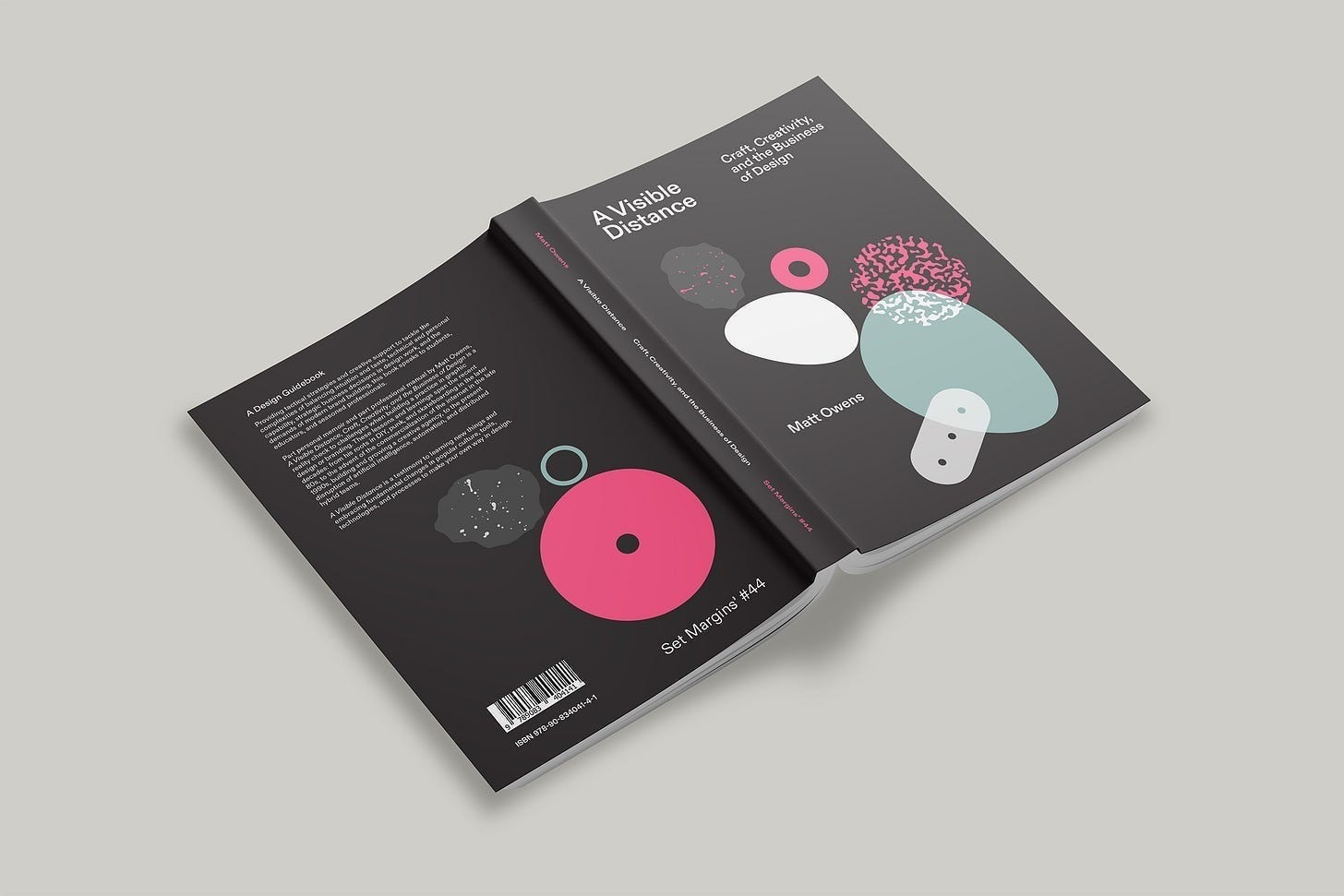
Buy my book: A Visible Distance, Craft, Creativity, and the Business of Design. Support independent publishing!

Athletics is the brand innovation studio of which I’m a founder, partner, and Chief Design and Innovation Officer. Brands come to us with ambition. We turn that ambition into a sharp vision and the tools to bring it to life in a noisy world. Our designers, strategists, and technologists partner with industry leaders across sectors to build lasting brand value with purpose and originality. Say hello.
You can find my longer form writing on Medium and my personal work on Instagram and my personal site.