
Creative Orchestration Layer
Nodes. Process. Agentic.


As AI tools, agentic systems, and automation become fully entrenched in modern work, we are seeing the inevitable adoption of fundamentally new workflows and thinking. But across all of our tools we have an interface overload problem and at the individual level a knowledge adoption and utilization problem.
To truly see, understand, and command the overall creative workflow of a business, traditional roles, hierarchies, and methods of management are changing. I call this the rise of the ”Creative Orchestration Layer.”
For organizations of all sizes, AI adoption has been spotty because it is hard to create a rigorous framework for adoption when there are so many ways to interconnect our varying suite of SaaS solutions and so many ways to leverage them to do work. Put simply, it’s a mess and no one person has the deep knowledge to solve it.
So what we are seeing is not a move toward “solving” but a move toward “managing” our complex AI, SaaS, creative software, and output stacks. The spaghetti under the hood can seem too hard to untangle. When you are in the work, there are very few individuals that are adept across many tools and get their interrelationship. The full stack workers.
Within any company it is the native full stack workers that have the innate curiosity and energy to self-solve and adopt new tools and processes and interconnect them. But for most folks adopting new things at work needs to be a policy not a passion. Something as simple as moving presentations from Keynote to Figma can feel like you are shaking the foundation of how people work when in reality these kinds of incremental workflow evolutions are inevitable and need to happen more quickly.
Enter the Creative Orchestration Layer that helps us “see” the chaos. Visual data flow tools have been around since the late 1960s and one primary way of visualizing data flow is through a node graph. You can go back as far as Leonhard Euler’s Seven Bridges of Königsberg problem in 1736 that laid the foundation of graph theory.
A node graph is just a way of visualizing an inter-connected problem. Node based visualizations for people that use 3D programs like Cinema 4D and Redshift or are into Weavy or Runway, provide a very helpful way to visualize how a series of prompts, variables, and conditions can come together to produce an outcome.
Traditional administrative and business functions have historically been dependent on a basic combination of lists and proclamations. This is any spreadsheet, to-do, time line, or standard operating procedure. A proclamation is an announcement. This is an official communication like an all hands meeting or a presentation.
Lists and proclamations are helpful because they capture what needs to be done on the one hand and on the other they translate a list into something official that needs to be done. What these do not do is show the interrelationship, ingredients, and rationale that make the list and the proclamation matter. This is what a node based visualization can do.
There are a few products that people are building that sell this Creative Orchestration Layer to show how your internal workflows are interrelated and hopefully help the full stack workers lead businesses forward into a new era while others continue to play their part.
One good example is Monks.Flow. Monks are the digital agency and technology partner for many clients across countries and timezones with thousands of employees that need to generate hundreds of millions in revenue. They know the creative workflow spaghetti that exists within enterprise agencies more than anyone. Monks.Flow is essentially a visual layer that helps manage the complete marketing lifecycle while building in agentic smarts and the ability to integrate other tools with public APIs. Stagwell have their flavor of this called The Machine.
The basic idea is if our systems are disconnected then using a node based visual interface can help unify them and work together.
In my view, an end to end visual interface that ties all of your workflows together might feel like overkill. More importantly, some of your full stack workers are probably the only people who will really command the entire ecosystem. Most workers will live in the nodes that fit their jobs because ultimately for administrative functions you are still making lists and proclamations. Just in a more agentic-infused manner.
Enter the Creative Orchestration Mindset. The folks that will win are the ones that have an orchestration mindset, a node based mindset, and the smarts to improve upon the workflows and outputs using AI.
The problem as I see it is that we have too many smart things that do too many smart things. Training a model can take more time than just doing the thing. Setting up automations can take more time than just copying and pasting. I only use a small percentage of the tools I enjoy most using day to day including Slack, Notion, Weavy, After Effects, Pipedrive, Cinema 4D, Google Docs, Figma and others. Each of these have a specialized UI unique to what they do and even if I had infinite free time there is not enough time in the day to become a master at all of them.
So the Creative Orchestration Mindset helps take all these discrete tasks and the partial knowledge we need to do them and helps us make sense, hopefully improve, and as a later byproduct, become more efficient at a higher quality of output.
Agentic tools combined with more powerful software are helping us redefine our old lists and proclamations and to use visual node-based UI to visualize, maintain, and collaborate allowing us to create sub-routines to empower discrete tasks and projects and then to operationalize them for teams.
This is the new normal. Administrative functions are evolving. Full stack thinkers and full stack workers have become the tip of the spear. Fewer people are doing more orchestration for the less savvy downstream. Lists and proclamations are ingested into the hive mind, are never forgotten, built upon, and remain useful.
The Creative Orchestration Mindset and the software layers that support it can help us have better command over the flywheel effect by seeing it both from above and within. What we have to keep in mind is that reducing bloat, going faster, being more efficient, and automating are all byproducts. But it is not actually about that.
When you focus too much on the internal, you run the risk of falling into organizational myopia, institutional narcissism, and vendor centric priorities. The Creative Orchestration Mindset and its supporting tech are really the machinery to foster a better service driven business culture that can accelerate and reinforce an external market orientation, client centric behavior, and a stewardship orientation toward what we do and the value we bring.
How you might start
To start you have to visualize your orchestration stack and define each role in the stack. These could simply be broken down into something like the following:
Inputs. Such as docs briefs and budgets
Intelligence. Such a GPT, Gemini, Claude, or agents you use
Systems. Such as Notion, Figma, Pipedrive, or automations you use
Decisions Such as signoff, approval, and feedback.
Outputs. Such as presentations or file types
Once you have these defined you can make a starter orchestration map and apply it to a real project you have completed. Before you pick a piece of software, I would map a few flows out in Figjam or something similar so you can see what is going on and to visualize your own flavor of spaghetti under the hood. From there, you can use any number of AI tools, like Chat GPT, to ingest all that you have learned and to decide the right tool for you to start. This could be a tool like Zapier Canvas, Make or n8n.
Remember, embrace a Creative Orchestration Mindset first to help you choose the tight tools for your unique processes and ways of working.
From Across my desk
Looking into. Claude Cowork. Give Claude access to your local files, set a task, and step away. Come back to completed work.
Watch. My brother turned me onto LaReezy a 20-year-old rap artist from New Orleans, On a mission to inspire a generation of people to pursue their dreams, fulfill their purpose, and strive to become a better version of themselves.
Read. Are we ready for the next great American electric car brand?
Check Out. Athletics’ ECD and partner Malcolm Buick brings his brand building talent to his home town boxing gym — Arbroath Amateur Boxing Club. Heritage with a Punch
Shameless self promotion
I love helping folks through: Speaking. Consulting. Critique. Writing. Design. Please reach out. I’m always down to help.
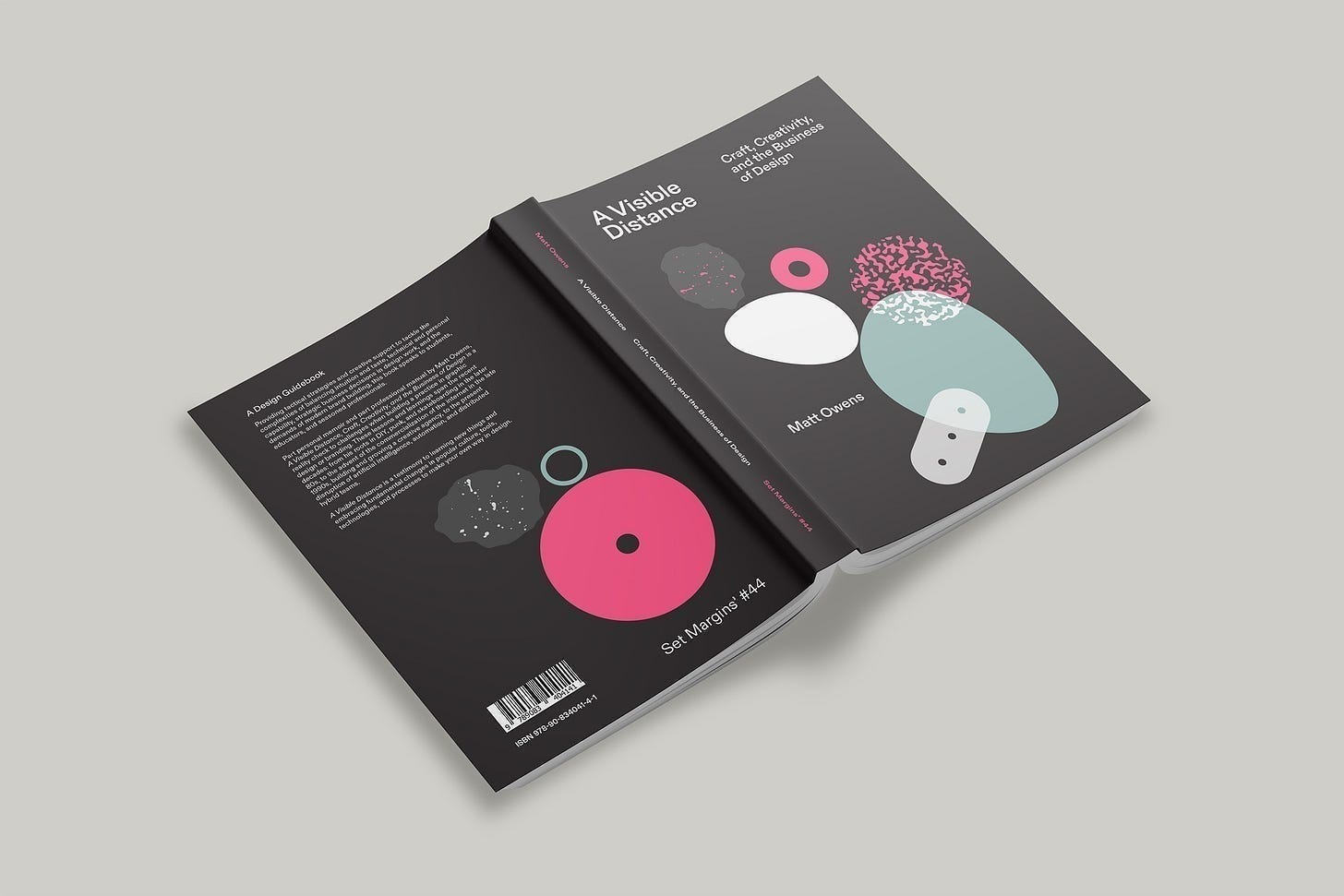
Consider buying my book A Visible Distance, Craft, Creativity, and the Business of Design, as well as the other publications by Set Margins. Support independent publishing!
You can find me my longer form writing on Medium and my personal work on Instagram and my personal site. More of the 3D illustrations I create for my articles can be found here.

Athletics is the brand innovation studio of which I’m a founder, partner, and Chief Design and Innovation Officer. Brands come to us with ambition. We turn that ambition into a sharp creative vision and the tools to bring it to life in a noisy world. Our designers, strategists, and technologists partner with industry leaders across sectors to build lasting brand value with purpose and originality. Please say hello.