
Leadership Lessons
Coach. Consult. Mentor.


Due to the slings and arrows of entrepreneurship, it has been on my list to look into executive coaching to understand the coaching process to see if it was the kind of thing that one should invest in for themselves or for others in your business. What better way to see what it is all about than to do it. What follows is a digest of what I learned and what the process uncovered for me.
The first question I asked myself was if executive coaching is what you do when you want to get better as a leader or is it a thing people make you do when you need to improve as a leader? Or perhaps a bit of both? In the past I believe there has been a degree of stigma around coaching in corporate America and perceived as something you did because you were weak in some area or not at the level you need to be. Fast forward to today and executive coaching, like other self optimization strategies, is seen as a tool to maintain your resilience, perspective, and retain an elite level of mental and creative skill as your business grows in complexity.
So is coaching all it’s cracked up to be? The short answer is yes, executive coaching is very useful, will make you a better person / leader, and will ultimately give you new tools to help you personally and professionally and will help improve your business. For many the cost and time commitment for any self-investment like coaching is a blocker. The outlet and perspective coaching provides at the leadership level is invaluable. I recommend that businesses save up and set aside the funds and time and require everyone from directors upward to do some level of executive coaching. It is good professional medicine.
For me some executive coaching, candid tough talk, and cerebral unpacking was much needed. I went out on my own and started my first creative studio in the summer of 1999. Twenty six years later, I’m still at it and still learning as if it was my first day at work. When you start a small business, you start in the position of doing everything because you are truly responsible for everything. If you are restless like me, this is heaven because you learn, make mistakes, and build every aspect. As a business grows, and as you bring on new people and new roles, your position changes. Some leaders let go and hand certain responsibilities over to others. Other leaders prefer to stay in the trenches and have a line of sight on all things to ensure that things run well relationally. This is especially true for a creative maker / leader that knows that ultimately what you create is what people pay you for and that all the non-creative tasks are in place to service and support the making.
At a certain scale, I’d say between twelve and twenty people, a creative business starts to have a front and back of house. The front is the people and creative work that people pay you for. The back is the administrative functions and tasks that support the creative work. Over time what often ends up happening as a business grows is the back of the house begins to become larger (to support more people) and business administration begins to subsume creative bandwidth and establish its own priorities that can often feel antithetical to the creative making part of the business. As you start to have different business functions and roles and a siloing as a result, complications can occur around authority, who does what, the best business structure, prioritizing efficiency over effectiveness, and focusing more on the needs of today than preparing for the needs of tomorrow. This is not unique to creative agencies and happens in all businesses on some level as they grow and evolve.
This is when some focused executive coaching can be of real benefit. To better navigate business growth and its resulting complications more effectively, leaders need to snap into a heightened level of self awareness. Executive coaching, as a process of open business-focused dialogue and inquiry with a neutral party, can give you tools to evolve your mindset, your expectations, your role identification, and your relationship to your business to navigate its evolution from a place of deeper context and presence to make it and yourself better.
My first big insight from leadership coaching is that a business is neither a machine to be built nor an organism to be raised or governed. Metaphorically, running a business can feel like controlling the course of water or building and maintaining the parts of a car. In reality businesses are more like a dynamic human being that is made up of other dynamic human beings. At their core, businesses are really just a self created series of ever evolving agreements with other individuals and your role and actions at any level influences that system. And the phenomenon of influence in many ways is far more interesting and impactful than control.
What executive coaching in my experience uncovered is that a lot of what frustrates us all about work is when our human condition collides with our collective interactions in the context of business activities. What this means is that at a very foundational level our work as leaders and employees can and will surface some degree of human bias, ego, self interest, suffering, effort, gratitude, altruism, critique and many other human feelings, expressions, and actions. The central nervous system of every business is on some level an expression of the individuals in their roles and the human idiosyncrasies they bring to the table.
Through regular and semi-rigorous inquiry, leadership coaching helped me recognize the weirdness I also bring to the equation. This includes but is not limited to — being a creative martyr, putting the interests of business over one’s personal life, issues with fairness, equal effort, punctuality, egotism, inflexibility, speed in decisioning, craft, skill, and many other things that cloud and influence your judgment at any given moment. Sometimes to great benefit and sometimes to great detriment.
We are all bringing our bag of bias’, points of view, and values to the table at work and the key to good leadership at any level is an awareness of this and an ability to recognize how to modulate our thinking and behavior to best suit the situation. My coach, Natalie Davis, was a true gift. She helped me hold a mirror up to myself. She helped me uncover tools to help me find the breathing room to interrogate my own thinking before acting. To some degree we are all blind and narrow. We all fall back on our most comfortable patterns and want to feel good about ourselves. Executive coaching gave me a renewed interest in self inquiry to better manage my own expectations and my own inner monologue while also recognizing, and appreciating, these same challenges in others.
When it comes to leadership, I am merely one oarsman who helps steer the business through the economic and creative weather and my incremental actions can have a great deal of influence. Having the most context and a deeper view of what we are doing and what is happening helps me steer better. Like a hand-made canoe, we are all in different craft navigating the same currents.
So how do we all stay sane in the corporate tempest? Coaching taught me that as a leader it is your job to work hard to productively detach so that you can make better decisions that are not connected to your own personal presumptions and intuitive views on what might be best. Leadership is about knowing how to struggle well. It’s about teaching yourself that you are one part of the system. Your job is not to control, it is to productively influence and empower using the most information at your disposal possible.
I am often haunted by the knowledge that this fragile thing called a business is merely an assemblage of agreements, people, and processes that everyone relies on to generate the income to sustain our lives. When seen in this way, I can see leaders feeling they carry a heavy burden. I can also see the opposite where you have the Steve Jobsian impulse to believe you are the oligarch of the organization’s success and everyone should do as you say. Both of these perspectives are wrong.
Leadership coaching taught me to stop making work so deeply personal and tied to my own self worth. Like the forecast, we can not control all of the things that influence the success of a business and we should work hard to not beat ourselves up when things get challenging.
The secret sauce, for me at least, is to deeply care about the artistry and philosophy of work and to find great joy in the depth with which a business can shine a bright light on our human condition in all its complexities. The second and most critical ingredient of this sauce is to simultaneously translate the deeper business view you have as a leader into bite sized action oriented activities and influences that enable employees to feel good about what they are doing to move themselves and the work forward.
Most everyone that is not an owner of a business comes to work in their own way and, rightfully, views work as just one aspect of who they are and what they do. The nuances, small details, and larger interconnected interdependencies that make a business more than just a business — an art form, an iconic brand, a magical place — is not what most people spend their mental energy on. We are “what is my task” oriented by nature and it is difficult for people to easily move between the philosophical richness and the operational mechanics that work provides while also deeply understanding that all of it is in service of making great creative things for our clients to help their businesses succeed.
Executive coaching is a great and deeply personal exercise that, in my view, will make you better. No question. Having a mental engine fueled by self awareness and reflection, actively seeing the bigger context and interconnectedness, and modulating your actions to best suit circumstances is a super power.
But it requires work to sustain!
From Across my desk. Executive coaching addition.
Check out Executive coach, entrepreneur, and craftsperson Natalie Davis.
There is a great video of President Barack Obama that has circulated over the years about how being really good at describing or explaining a problem or situation is something that is exceptionally common but what is very rare are individuals that say yes, take something on, figure it out, and self learn and self solve.
Terms to use in your next Zoom call:
Seek The Overview Effect that astronauts have that allows us to see the fragility and interconnectedness for it all.
Avoid The Barnum Effect where we believe in generalities and think it all applies directly to us.
Recognize The Illusion of Explanatory Depth. where people tend to believe they understand a topic better than they actually do.
We should all strive to be Ambiverts.
Shameless self promotion
Creative leaders, agencies, clients, educators, and folks that seek a bit of professional objectivity or an extra creative hand often reach out to me. I’m always down to help.
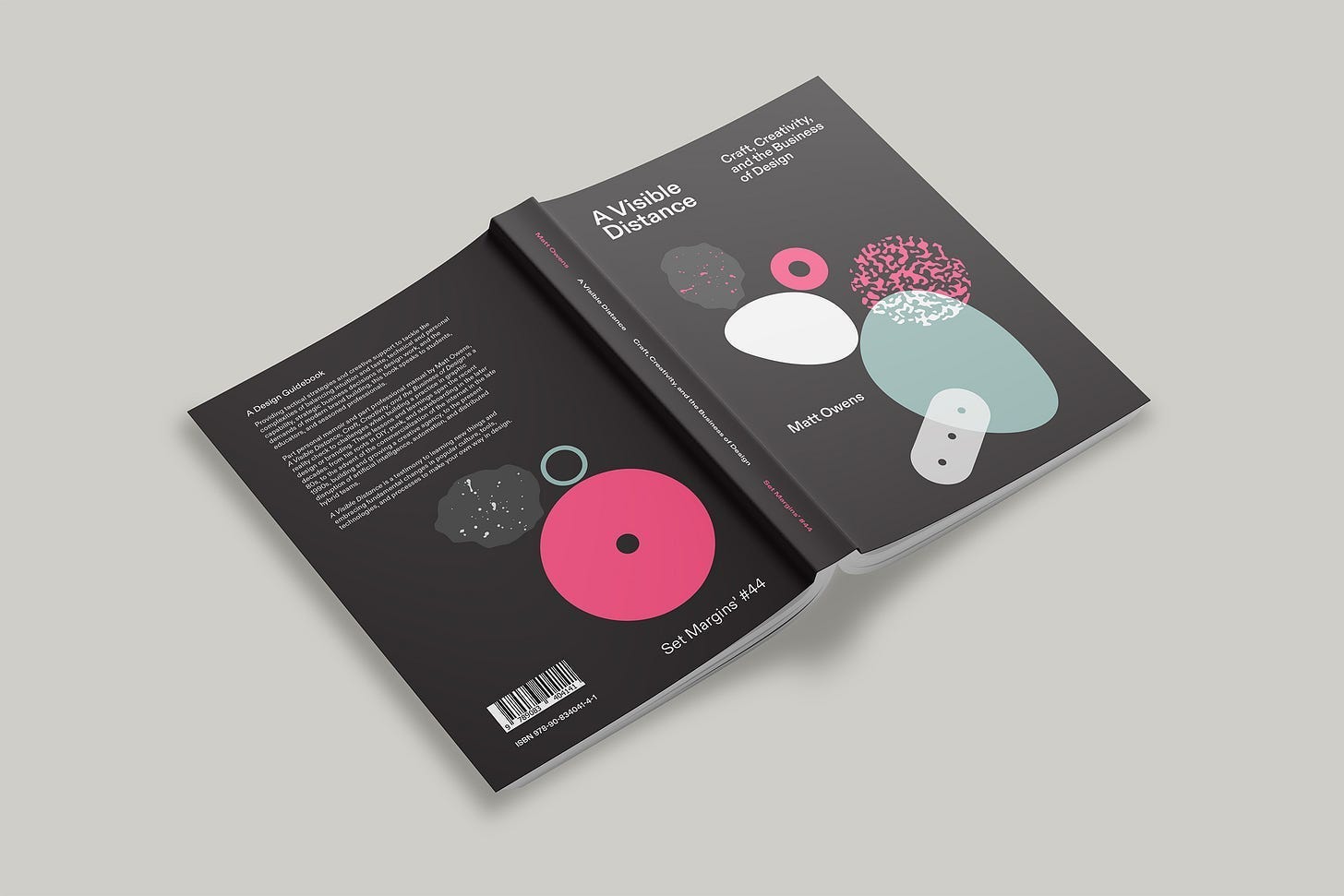
Check out my book A Visible Distance, Craft, Creativity, and the Business of Design, as well as the other publications by Set Margins. Support independent publishing!
You can find me my longer form writing on Medium and my personal work on Instagram and my personal site.

Athletics is the brand innovation studio of which I’m a founder, partner, and Chief Design and Innovation Officer. Brands come to us with ambition. We turn that ambition into a sharp vision and the tools to bring it to life in a noisy world. Our designers, strategists, and technologists partner with industry leaders across sectors to build lasting brand value with purpose and originality. Say hello.
The Illustration at the top of this post is some Cinema 4D tests I did using spline wraps. More to come.